Friday, September 30, 2011


Tuesday, August 30, 2011
Call for Missile Defense in Taiwan

It is time for those in Taiwan's government who are loyal to Taiwan as well as the DPP presidential candidate to request from Israel to supply and help deploy its Iron Dome defense system in Taiwan.
It will be good for stories to circulate on the wire services about Taiwan attempting to acquire Iron Dome defense. Such reports will focus much more on China's threat than the more general attempts of Taiwan to purchase fighter planes.
The mere calling for the system will concisely highlight to the international media and foreign nations the ongoing threat of China's missiles against Taiwan.
Here's a recent Washington Times article on Israel using the system: Israel’s ‘Iron Dome’ missile defense system hits 85% of targets
Monday, August 29, 2011
The absurdity of the KMT / Ma position regarding the ROC
Ma keeps throwing around the fictional "1992 consensus." The word "consensus" always excites the foreign press corps. But the following video shows the absurdity of the KMT and the R.O.C. constitution of their government in exile.
Monday, August 1, 2011
Using online animation tools to make the point.
Make at goanimate.com
Post on youtube.com
Link on facebook.com
Embed on blogger.com, wordpress.com, tw.myblog.yahoo.com, etc.
Tuesday, July 12, 2011
China's communist government policies becoming a stench in the nostrils of at least some
The continued imperialist and dictatorial policies of China's regime have consequences, even on a small scale. Recently in one small college town in Alabama, a Chinese company's bid on city-owned property was thwarted expressly because of city council members' distaste over China's regime and policies.
"In a whirlwind of emails since last week's City Council meeting, an offer from a Chinese company that wanted to buy the 155 acre former golf and country club was withdrawn after two members of the council made highly negative comments about China and its communist government..."
Meanwhile, president William Cale of the local university which has a large number of international students from China has embraced a more kowtowing attitude, calling the anti-China views "prejudicial" and not consistent with the "pluralistic" philosophy of the university.
Read more: Times Daily
==============
DEMO! thinks that local governments of other nations should be very careful about allowing China's companies getting a foothold because if the recent experience in Africa is any evidence, China's companies are imperialistic in nature. The Chinese regime has fanned an extreme ultra-nationalism in China on the level of Naziism or the Japanese imperialism of World War II. Unlike America's good experience with Japanese car companies opening plants in the U.S., when the Chinese companies set up businesses and factories in other countries, it is often not for the benefit of the local countries. All for mother China.
That local governments are desperate to attract Chinese companies shows already the predatory practices of China that have caused a loss of manufacturing and jobs in the U.S.
Note how in this particular case, the Chinese company wanted to create a training facility that would expand its market in the U.S. rather than cause an increase in local manufacturing. They wanted to expand sale of their products made in China, not produce anything locally in America.
"In a whirlwind of emails since last week's City Council meeting, an offer from a Chinese company that wanted to buy the 155 acre former golf and country club was withdrawn after two members of the council made highly negative comments about China and its communist government..."
Meanwhile, president William Cale of the local university which has a large number of international students from China has embraced a more kowtowing attitude, calling the anti-China views "prejudicial" and not consistent with the "pluralistic" philosophy of the university.
Read more: Times Daily
==============
DEMO! thinks that local governments of other nations should be very careful about allowing China's companies getting a foothold because if the recent experience in Africa is any evidence, China's companies are imperialistic in nature. The Chinese regime has fanned an extreme ultra-nationalism in China on the level of Naziism or the Japanese imperialism of World War II. Unlike America's good experience with Japanese car companies opening plants in the U.S., when the Chinese companies set up businesses and factories in other countries, it is often not for the benefit of the local countries. All for mother China.
That local governments are desperate to attract Chinese companies shows already the predatory practices of China that have caused a loss of manufacturing and jobs in the U.S.
Note how in this particular case, the Chinese company wanted to create a training facility that would expand its market in the U.S. rather than cause an increase in local manufacturing. They wanted to expand sale of their products made in China, not produce anything locally in America.
Saturday, July 9, 2011
"Taiwan" National Party (TNP, 台灣民族黨)
Taipei Times reports the announcement of the formation of a new political party, the Taiwanese National Party (TNP, 台灣民族黨), on July 8, 2011. Forming new parties may or may not be effective. One wonders about the reach of some of the smaller parties. Should the pro-Taiwan folks be united, or divided into separate parties? United we stand; divided we fall?

Since the DPP is pro-Taiwan but also tends to the left, Taiwan could ultimately use a pro-Taiwan party on the right. It is not yet clear what the TNP will become. The name has its good points. Changing the English translation of 台灣民族黨 to "Taiwan National Party" instead of "Taiwanese ..." will help point journalists towards focus on a country rather than them assuming this party is an organization of a supposed "separatist" ethnic group.
It is good that this party seems to be looking outwardly to learn from the experience of other nations, such as Estonia. If the party can form itself into an effective organization, it can be a good influence internationally. Imagine a reporter in Europe sitting down to talk with a representative of the "Taiwan National Party" versus a chat with the "Democratic Progressive Party." The former's name is unequivocal in its clear declaration of Taiwan as a nation. The official name of the latter could be more easily ignored by those with a one-China habit. They would just relegate it to a democratizing party in China.
One other thing to note: what are the demographics of the party? Can the TNP reach out to the younger generation?
Perhaps the best outcome of Taiwan having small parties could be if they can engage and mobilize a segment of the population that had been feeling marginalized. Taiwan needs more active and organized pro-Taiwan groups.
We need them to not just focus on the political process of getting candidates elected, but, at this crucial juncture in Taiwan's history, focus on reaching and educating the younger generation. Do not leave them to the propaganda of the KMT-derived education system, on the whole as of yet untouched by the democratic ideological transformation in Taiwan.
============================================
See Taipei Times Article below:
A group of pro-Taiwan independence supporters yesterday announced the formation of a new political party, the Taiwanese National Party (TNP, 台灣民族黨).
The party, to be officially established tomorrow, will seek independence for Taiwan through a national referendum.
A group of TNP members made the announcement on Ketagalan Boulevard in Taipei with the Presidential Office in the background, chanting the slogans “Long live the Taiwanese nation” and “Liberate the Taiwanese nation.”
“We are determined to resort to every possible method to achieve the eventual goal of independence for Taiwan,” said the unofficial leader of the party, Huang Hua (黃華), who used to be an adviser to former president Chen Shui-bian (陳水扁).
Huang, 72, then led TNP members to the nearby 228 Peace Memorial Park and took an oath in front of the Memorial Monument that commemorates the tens of thousands of people killed during the 228 Massacre in 1947.
Huang said the party, which currently has about 100 members, mostly senior citizens, will be a grassroots movement and plans to hold open public speeches nationwide to promote Taiwanese identity and garner support for independence.
Citing the example of Estonia, a former Soviet Republic which declared independence in 1991, Huang said the party aims to enlist Taiwanese who favor the establishment of a new country, before holding a national referendum and convening a constitutional convention.
Taiwanese have the right to determine their own future, Huang said, given that the ratification of the UN Charter in 1945 after World War II placed the right of self--determination into the framework of international law and diplomacy.
The Chinese Nationalist Party (KMT) government illegally occupied Taiwan and never gave Taiwanese an option in terms of their nationality, Huang said, adding that “legally speaking, Taiwanese still hold Japanese citizenship because Japan did not renounce its sovereignty over Taiwan until the Treaty of San Francisco in 1951.”
“After that, we became stateless people,” said Huang, who served four jail terms for a total of 23 years for participating in Taiwan’s independence movement.
The group of senior citizens felt that there was a need to advocate independence, which is still included in the Democratic Progressive Party’s (DPP) platform, but it “is doing nothing about it,” said Huang, who left the DPP in 2005.
Despite the party’s endorsement of the DPP’s presidential candidate, DPP Chairperson Tsai Ing-wen (蔡英文), in the presidential election in January, the TNP said it plans to nominate candidates for the legislative elections.
“Building a nation will help more people than building a hospital,” said Tom Yang (楊東傑), a physician who practiced in the US and organized independence groups in the 1950s.
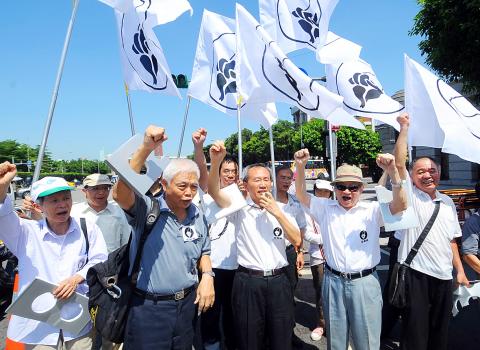
Since the DPP is pro-Taiwan but also tends to the left, Taiwan could ultimately use a pro-Taiwan party on the right. It is not yet clear what the TNP will become. The name has its good points. Changing the English translation of 台灣民族黨 to "Taiwan National Party" instead of "Taiwanese ..." will help point journalists towards focus on a country rather than them assuming this party is an organization of a supposed "separatist" ethnic group.
It is good that this party seems to be looking outwardly to learn from the experience of other nations, such as Estonia. If the party can form itself into an effective organization, it can be a good influence internationally. Imagine a reporter in Europe sitting down to talk with a representative of the "Taiwan National Party" versus a chat with the "Democratic Progressive Party." The former's name is unequivocal in its clear declaration of Taiwan as a nation. The official name of the latter could be more easily ignored by those with a one-China habit. They would just relegate it to a democratizing party in China.
One other thing to note: what are the demographics of the party? Can the TNP reach out to the younger generation?
Perhaps the best outcome of Taiwan having small parties could be if they can engage and mobilize a segment of the population that had been feeling marginalized. Taiwan needs more active and organized pro-Taiwan groups.
We need them to not just focus on the political process of getting candidates elected, but, at this crucial juncture in Taiwan's history, focus on reaching and educating the younger generation. Do not leave them to the propaganda of the KMT-derived education system, on the whole as of yet untouched by the democratic ideological transformation in Taiwan.
============================================
See Taipei Times Article below:
A group of pro-Taiwan independence supporters yesterday announced the formation of a new political party, the Taiwanese National Party (TNP, 台灣民族黨).
The party, to be officially established tomorrow, will seek independence for Taiwan through a national referendum.
A group of TNP members made the announcement on Ketagalan Boulevard in Taipei with the Presidential Office in the background, chanting the slogans “Long live the Taiwanese nation” and “Liberate the Taiwanese nation.”
“We are determined to resort to every possible method to achieve the eventual goal of independence for Taiwan,” said the unofficial leader of the party, Huang Hua (黃華), who used to be an adviser to former president Chen Shui-bian (陳水扁).
Huang, 72, then led TNP members to the nearby 228 Peace Memorial Park and took an oath in front of the Memorial Monument that commemorates the tens of thousands of people killed during the 228 Massacre in 1947.
Huang said the party, which currently has about 100 members, mostly senior citizens, will be a grassroots movement and plans to hold open public speeches nationwide to promote Taiwanese identity and garner support for independence.
Citing the example of Estonia, a former Soviet Republic which declared independence in 1991, Huang said the party aims to enlist Taiwanese who favor the establishment of a new country, before holding a national referendum and convening a constitutional convention.
Taiwanese have the right to determine their own future, Huang said, given that the ratification of the UN Charter in 1945 after World War II placed the right of self--determination into the framework of international law and diplomacy.
The Chinese Nationalist Party (KMT) government illegally occupied Taiwan and never gave Taiwanese an option in terms of their nationality, Huang said, adding that “legally speaking, Taiwanese still hold Japanese citizenship because Japan did not renounce its sovereignty over Taiwan until the Treaty of San Francisco in 1951.”
“After that, we became stateless people,” said Huang, who served four jail terms for a total of 23 years for participating in Taiwan’s independence movement.
The group of senior citizens felt that there was a need to advocate independence, which is still included in the Democratic Progressive Party’s (DPP) platform, but it “is doing nothing about it,” said Huang, who left the DPP in 2005.
Despite the party’s endorsement of the DPP’s presidential candidate, DPP Chairperson Tsai Ing-wen (蔡英文), in the presidential election in January, the TNP said it plans to nominate candidates for the legislative elections.
“Building a nation will help more people than building a hospital,” said Tom Yang (楊東傑), a physician who practiced in the US and organized independence groups in the 1950s.
U.S. Senator speaks out on China, Taiwan
U.S. Senator John Cornyn (Republican, Texas) on security and economic threats of China
"During his speech, the Senator also made a major point of supporting Taiwan's bid for F-16C/D's and encouraged the administration to move on it."
Subscribe to:
Posts (Atom)